
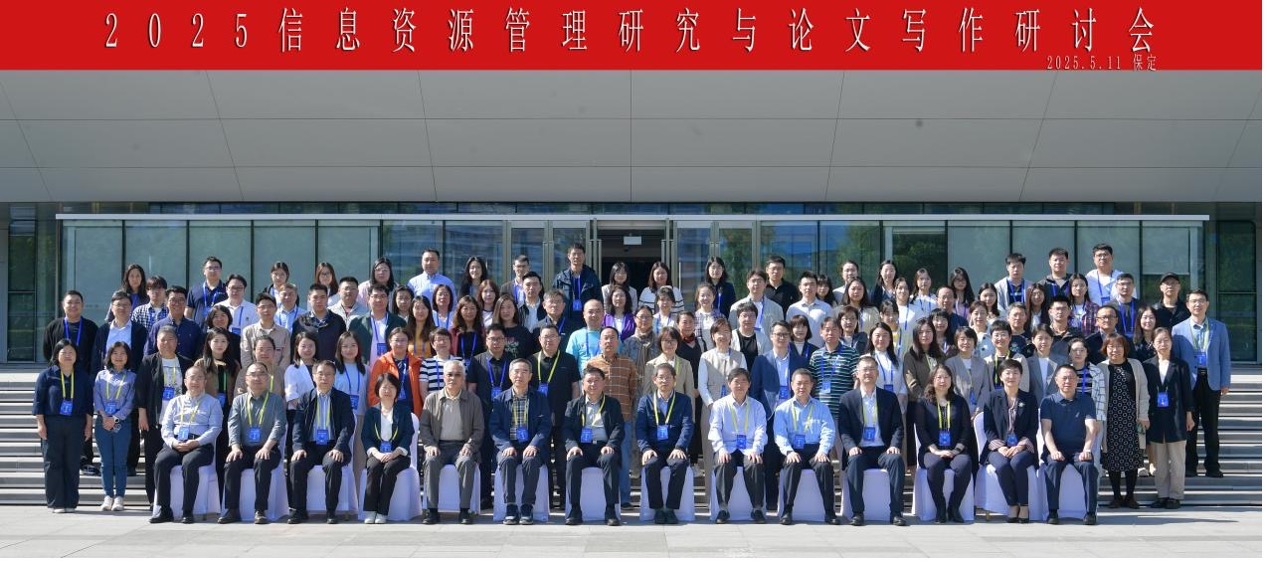
To thoroughly study and implement General Secretary Xi Jinping’s important discourse on developing new quality productive forces, and to effectively enhance the academic research and paper writing capabilities of scholars and professionals in the field of information resource management, the “2025 Information Resource Management Research and Paper Writing Workshop” was successfully held in Baoding, Hebei Province, on May 11–12, 2025.
Co-hosted by the National Science Library of the Chinese Academy of Sciences and Hebei University, and jointly organized by the editorial office of Library and Information Service and the School of Management at Hebei University, the workshop aimed to deepen participants' understanding of cutting-edge developments and academic innovations in the field, equip them with key academic research and writing skills, and foster the development of high-quality technical professionals in information resource management.
More than 130 experts, scholars, and practitioners from related research and application fields participated in the event.
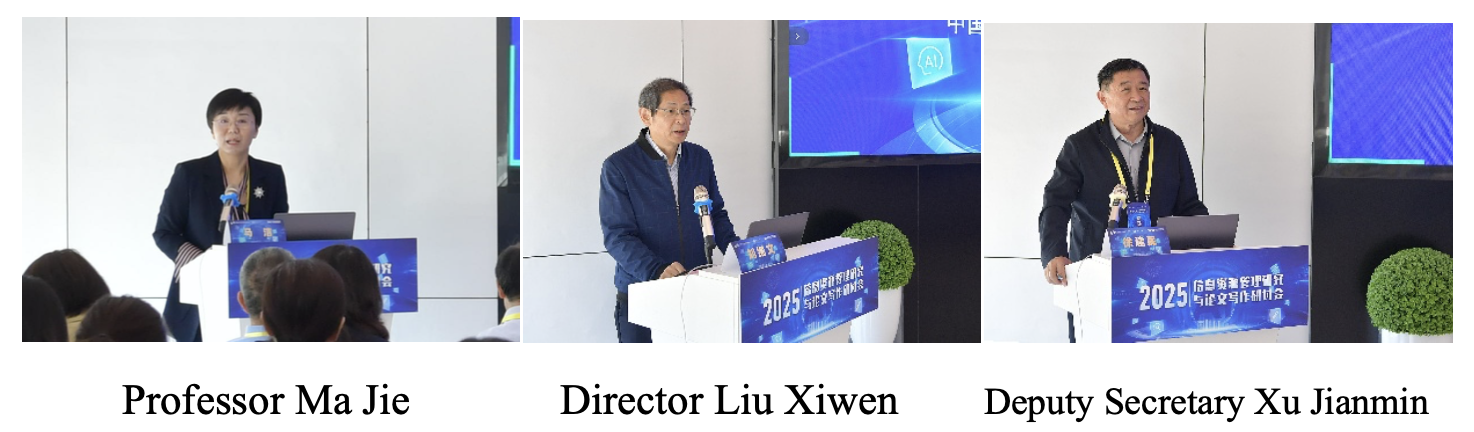
The opening ceremony of the workshop was hosted by Professor Ma Jie, Party Secretary of the School of Management at Hebei University. Liu Xiwen, Director of the National Science Library, Chinese Academy of Sciences, and Xu Jianmin, Deputy Party Secretary of Hebei University, delivered speeches.
On behalf of the National Science Library and the editorial office of Library and Information Service, Director Liu Xiwen extended a warm welcome to all experts and participants. He emphasized that artificial intelligence technology has had a broad and profound impact on academic research in the field of information resource management. As a top-tier comprehensive core journal in this first-level discipline, Library and Information Service precisely captures the pulse and direction of academic development. The outstanding research it publishes not only serves as a powerful driver for academic innovation but also significantly promotes the transformation and upgrading of industry practices. He noted that the journal’s annual "Academic Writing and Submission" workshop has become an important platform for supporting researchers' academic growth.
Deputy Secretary Xu Jianmin began by reviewing Hebei University’s century-long development. He highlighted that Hebei University is one of the few institutions in China originally established as a full undergraduate college. The School of Management has always placed the development of the information resource management discipline at the core of its strategic goals. Today, the new generation of information technologies is profoundly reshaping societal development, and information resource management—serving as a critical link between technology and society—is facing unprecedented opportunities and challenges. The various sub-themes of this seminar, he said, are timely responses to these pressing issues of our era. He concluded by wishing the conference great success.
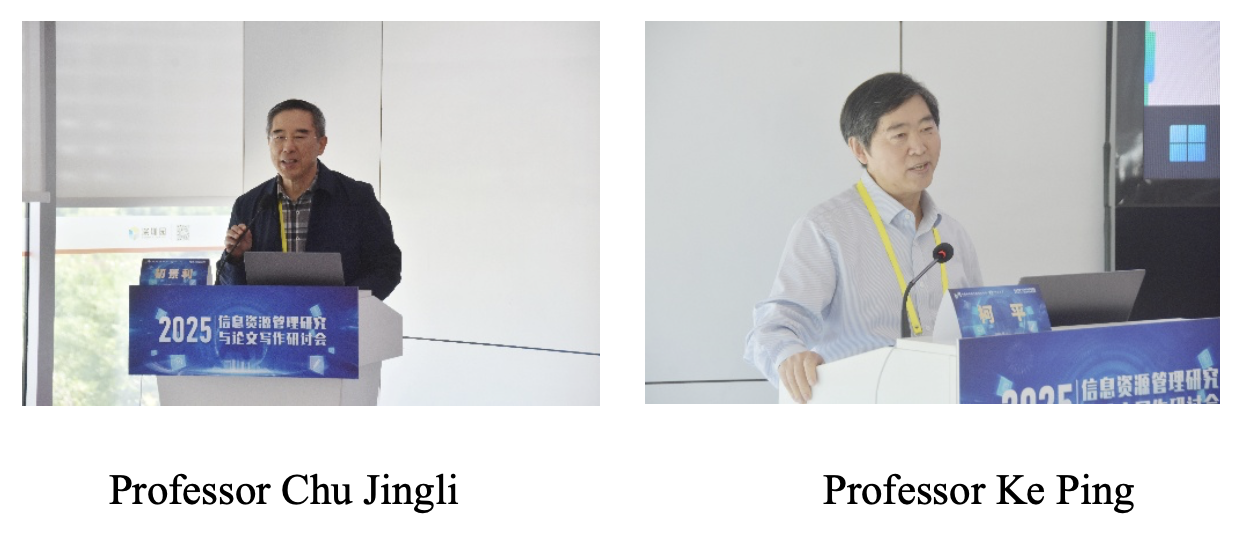
The first half of the morning session on May 11 was chaired by Professor Liu Bing, Dean of the School of Management at Tianjin Normal University and doctoral supervisor.
Professor Chu Jingli, Director of the Department of Information Resource Management at the University of Chinese Academy of Sciences and Editor-in-Chief of Library and Information Service and Knowledge Management Forum, delivered an academic report titled "Fundamental Understanding of Information Resource Management Research and Academic Writing." In his talk, he systematically outlined the methodologies and frameworks for research and writing in the field from ten key aspects: the nature and characteristics of the discipline, the significance of research and writing, their interrelation, the importance of topic selection, project proposal writing, normative requirements, issues of academic integrity, methodological approaches, enhancement of research and writing skills, and evaluation of research and writing outcomes. He emphasized that academic research requires deep thinking and a focus on research depth, and stressed the importance of continuously improving research literacy and writing ability through practice to ensure high-quality scholarly output.
Professor Ke Ping from the Department of Information Resource Management at Nankai University Business School gave a scholarly report titled "Frontier Topics in Information Resource Management Research." He provided an in-depth analysis of 18 urgent and emerging research topics in the field, including:
the 15th Five-Year Plan and the development of library, information, and archival science,
new quality productive forces and Chinese-style modernization,
AI and its applications in LIS and archival technologies,
data as a production factor and data science,
digital humanities theory and practice,
health information research and health informatics,
information behavior and user studies,
knowledge services and knowledge management,
information resources and information organization,
public culture theory and public cultural services,
nationwide reading promotion and information literacy,
smart libraries,
library management and services,
frontiers in intelligence theory and practice,
preservation of ancient books and the development of philology,
archival management in the era of intelligent digitalization,
the development and history of the information resource management discipline, and
future-oriented education in information resource management.
Prof. Ke’s report offered clear guidance for conference participants and future research.
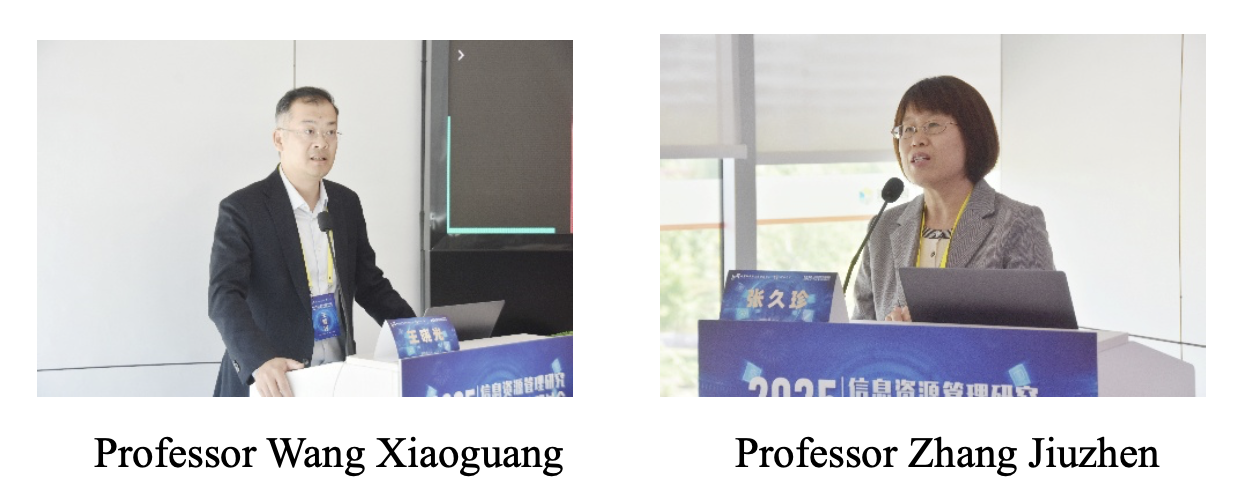
The second half of the morning session on May 11 was chaired by Professor Liu Bing, Dean of the School of Management at Tianjin Normal University.
Professor Wang Xiaoguang, Dean of the School of Information Management at Wuhan University, delivered an academic presentation titled “Research Topics and Methods in Digital Humanities.” He explored in depth the conceptual connotations of digital humanities, as well as its research and practical applications. He noted that while digital humanities has made encouraging progress in areas such as the development of digital resources and data modeling, there remains a pressing need for ongoing methodological and practical innovation to address emerging challenges. He also outlined future directions for digital humanities, including the construction of intelligent data resources, the development of new research methods and tools, and the exploration of novel issues arising from digital phenomena.
Professor Zhang Jiuzhen, Director of the Institute of Publishing Studies and Chair of the Department of Information Management at Peking University, gave an academic report titled “Academic Norms in the AIGC Era.” Her talk offered an in-depth discussion of the ethical and regulatory issues—and the challenges to academic integrity—posed by the widespread application of AI-generated content (AIGC) in academic research, scholarly writing, and educational assessment. She also introduced the policies and measures adopted by national authorities, academic institutions, and the publishing industry to ensure the responsible use of AI technologies and uphold academic integrity. In conclusion, she emphasized that in the face of rapid advancements in AI, the discipline of information resource management must continue to uphold academic ethics and integrity while actively responding to new challenges.
The first half of the afternoon session on May 11 was chaired by Professor Chu Jingli, Director of the Department of Information Resource Management at the University of Chinese Academy of Sciences and Editor-in-Chief of Library and Information Service and Knowledge Management Forum.
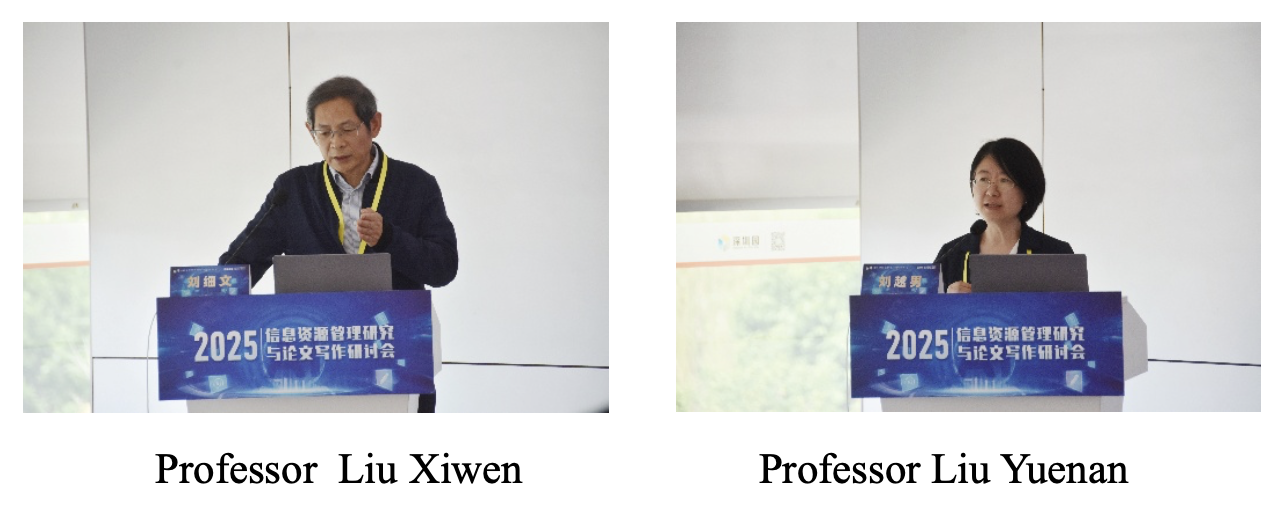
Professor Liu Xiwen, Director of the National Science Library of the Chinese Academy of Sciences, delivered an academic report titled “Research Methods and Academic Writing in Information Science.” His presentation addressed four key questions: What is information science? What does it study? How is research in this field conducted? And what are its future prospects? He systematically explained the fundamental concepts of information science and the evolution of its research themes, with a particular focus on the development and practical application of research methods in the field. Looking ahead, he discussed how AI technologies—especially intelligent agents—will reshape the paradigms of scientific and technical information work and revolutionize research approaches, thereby enhancing the efficiency and impact of information services in the age of deeply integrated artificial intelligence.
Professor Liu Yuenan, Dean of the School of Information Resource Management and Deputy Director of the Institute for Digital Humanities at Renmin University of China, presented a report titled “Research Methods and Academic Writing in Archival Science.” She outlined the philosophical foundations of archival research, the paradigms of social science research, and specific methodological approaches used in the discipline. She stressed the importance of applying and innovating theoretical methods to advance the development of archival science. On the topic of academic writing, she provided a detailed analysis of key stages such as topic selection, methodological application, demonstrating innovation, and revising the manuscript. Through concrete case studies, she illustrated how integrating theory with practice, blending traditional and emerging topics, and managing the scope of a research topic can contribute to producing high-quality academic papers in archival science.
The second half of the afternoon session on May 11 was chaired by Professor Yang Guoqing, Deputy Dean of the School of Management at Hebei University.
Professor Liu Bing, Dean of the School of Management at Tianjin Normal University, delivered an academic report titled “Data Analysis and Application in Information Resource Management Research under the Data Science Paradigm.” His presentation focused on the paradigm shift and disciplinary integration driven by data science, highlighting core data analysis methods, typical applications, and current challenges. He emphasized the critical role of data analysis in interdisciplinary research, in expanding the boundaries of research objects, and in driving intelligent transformation. Through case-based literature analysis, he underscored that high-quality research requires a solid theoretical foundation, reliable data sources, appropriate methodological application, and attention to ethical and social responsibility. He also analyzed issues such as data quality, methodological applicability, and ethical lapses currently present in research, and called for greater attention to the profound influence of the data science paradigm on research methodologies and cognitive logic.
Professor Cao Shujin, Dean of the School of Information Management at Shandong University of Technology, gave an academic presentation titled “The Application of Artificial Intelligence in Information Resource Management.” He began by reviewing the development of artificial intelligence and stressed the transformative impact of large models on the generalization of AI and their deep influence on the field of information resource management. Using examples such as topic identification, information extraction, classification, and data visualization, he demonstrated how generative AI can significantly enhance the efficiency and accuracy of information processing. He further explored the value of intelligent agents in solving complex problems and envisioned the future of deep integration between AI and information resource management. This includes enhancing intelligent user experiences, developing intelligent agents, driving service innovation, and addressing social challenges. In conclusion, he urged researchers to actively embrace AI technology—becoming not only its users and adopters but also its creators—to drive the transformation and high-quality development of disciplinary research.
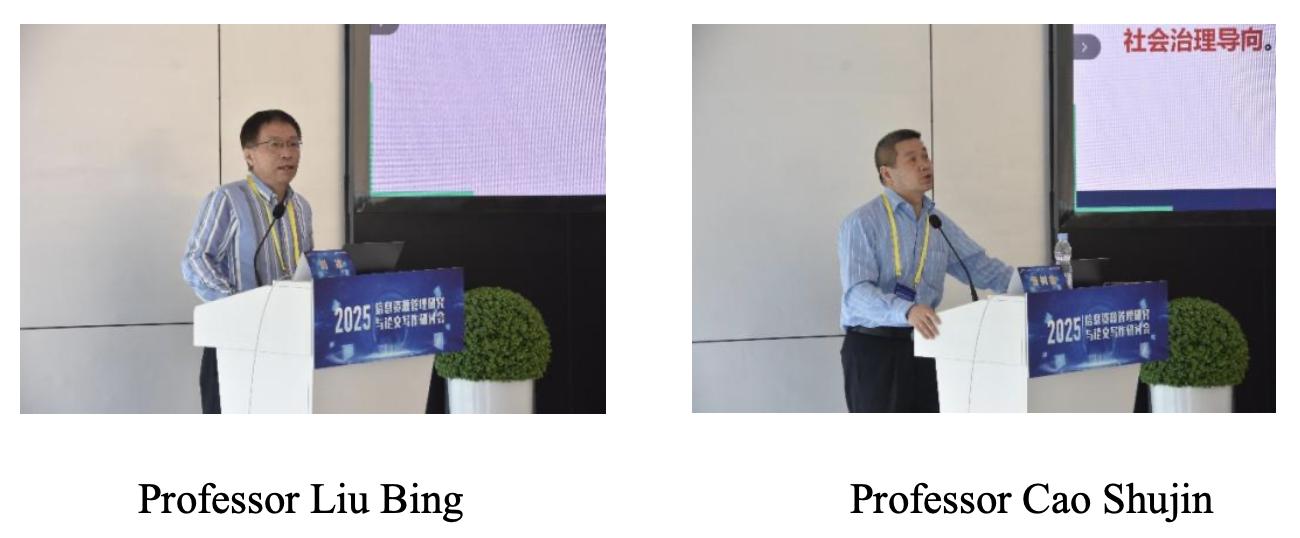
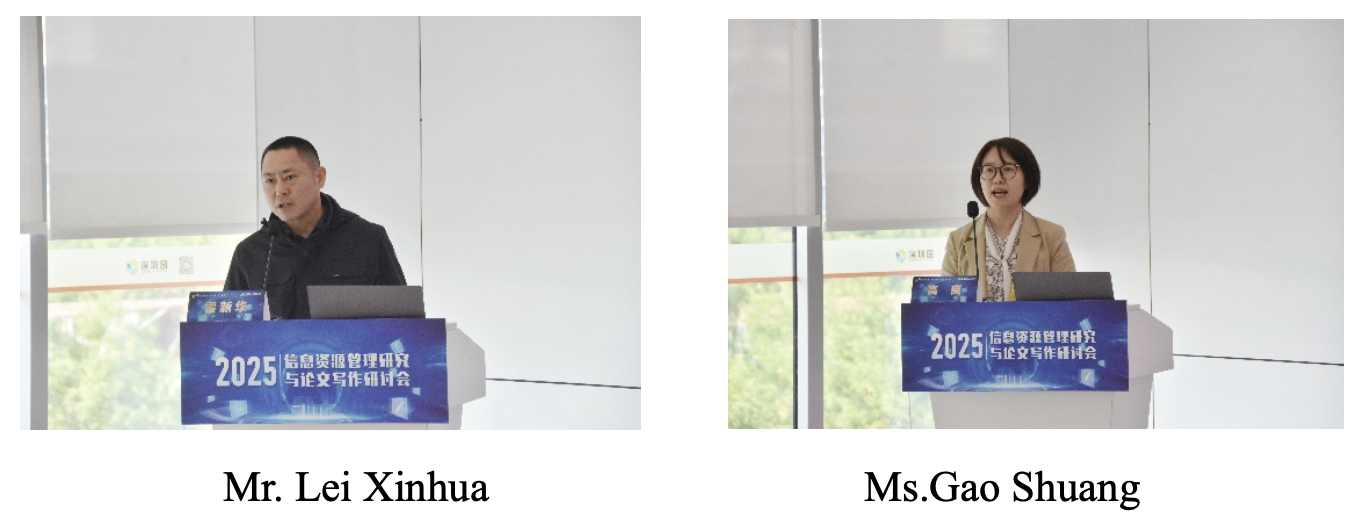
Mr. Lei Xinhua, General Manager of Beijing Souzhi Data Technology Co., Ltd., delivered an academic report titled “Innovative Practices in the Management and Application of Numerical Information Resources Driven by New Quality Productive Forces and Artificial Intelligence.” He emphasized the significant role of AI in enhancing teaching efficiency and optimizing data governance. While artificial intelligence presents valuable opportunities for innovation, he noted, it also introduces challenges such as data security, algorithmic bias, and technological dependence. In response, he shared his team’s management strategies and products designed to ensure data accuracy and reliability. He also demonstrated AI-based methods for data processing and analysis, aiming to promote improved research efficiency and the intelligent transformation of information resource management.
Gao Shuang, Director of the Editorial Office at the National Library Press, gave a report titled “Supporting the Development of Information Resource Management through Academic Publishing at the National Library Press.” She introduced an overview of the Press’s academic publishing efforts, its initiatives in supporting scholarly publishing in the field of information resource management, and shared common issues encountered during manuscript preparation and writing.
The morning session on May 12 was chaired by Professor Yang Xiudan, Director of the Department of Library Science at the School of Management, Hebei University.
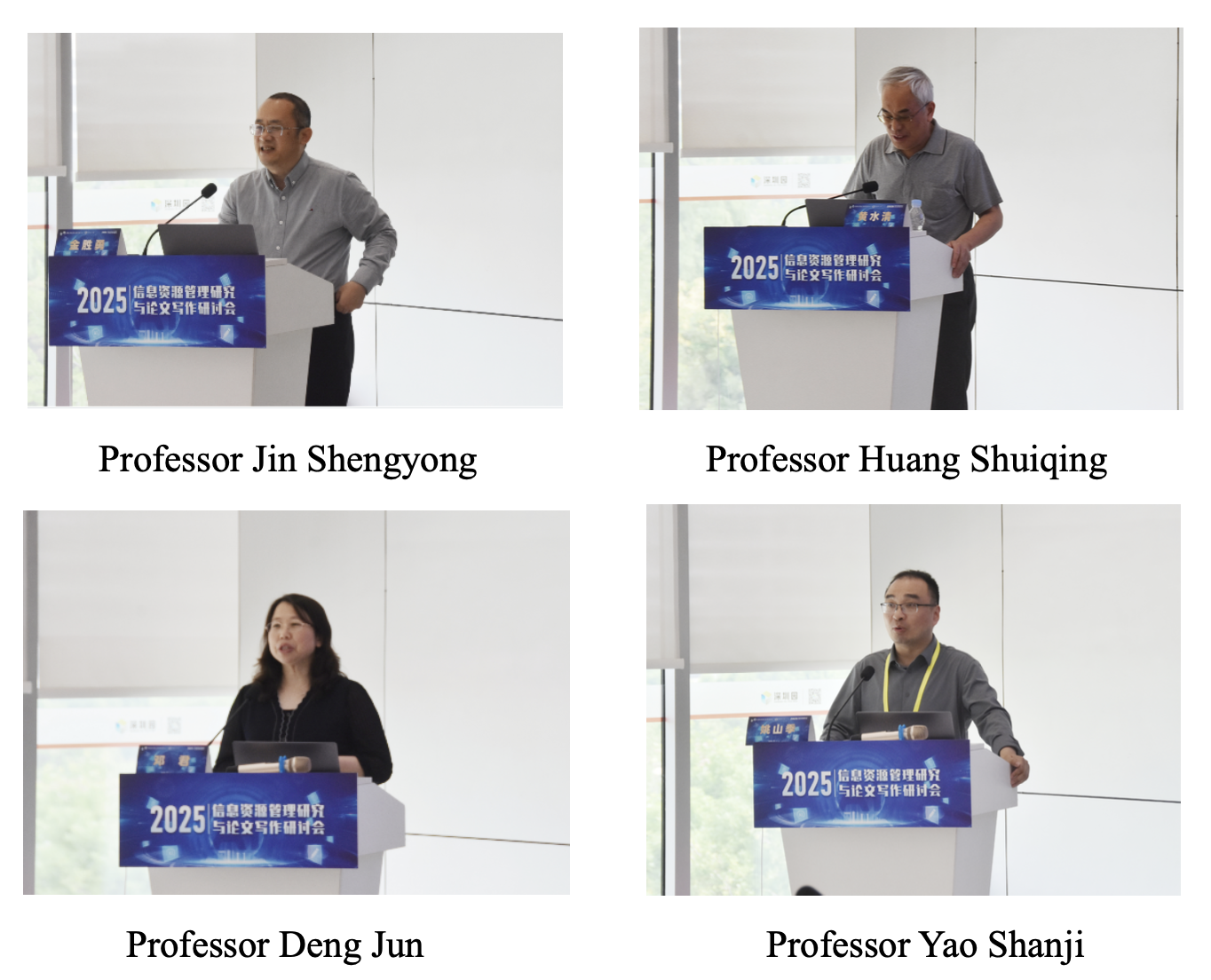
Professor Jin Shengyong, Director and Party Secretary of Hebei University Library, delivered an academic report titled “The Logic, Structure, and Key Issues in Library Science Paper Writing.” He emphasized that most scientific research requires hypotheses, and that topic selection and writing should be grounded in hypothesis testing. Studies lacking clear hypotheses may struggle to yield convincing conclusions. He advocated for adherence to basic principles of logical thinking, ensuring that arguments are well-founded, truthful, and strongly support the conclusions. He also noted that the structure of a paper should vary according to the type of research, and encouraged scholars to focus on research depth and the readability of their papers, while avoiding overly complex methods and inappropriate use of cases.
Professor Huang Shuiqing from the School of Information Management at Nanjing Agricultural University gave an academic presentation titled “Strategies for Applying for Research Projects in Information Resource Management.” He discussed in depth the significance of research project applications from six perspectives: what constitutes a research project, its key components, how to select a topic, main funding channels within the discipline, the role of the proposal, its basic format, and core elements. He pointed out that many common issues encountered during the application process can only be addressed through accumulated experience. Research projects should have clearly defined objectives, be completed on time and within budget, and be accompanied by a detailed proposal that clearly articulates the project’s content, quality, and resource allocation. In addition, he stressed the importance of selecting an appropriate research topic, advocated for thorough preliminary research, and analyzed the application procedures and funding channels, distinctions among various grants and project types, and key considerations during the application process.
Professor Deng Jun, Chair of the Department of Information Management at the School of Business and Management, Jilin University, delivered an academic report titled “Types and Case Analysis of Digital Humanities Research Papers.” She reviewed the evolution of digital humanities from humanities computing to its modern conceptualization, highlighting that digital humanities research papers encompass types at the epistemological, methodological, axiological, and technological application levels. She emphasized that digital humanities research involves not only the application of technical tools but also requires attention to theoretical innovation, ethical considerations, and the critical use of technology. Additionally, she stressed the importance of talent cultivation and education to keep pace with the rapid development of the digital humanities field.
Professor Yao Shanji, Dean of the School of Economics and Management at Nanjing University of Technology, presented a report titled “Characteristics and Research Directions of Interdisciplinary Studies.” He began by reviewing the concept and evolutionary development of interdisciplinary studies and outlined six core features: disciplinary integration, problem orientation, innovativeness, dynamic openness, application extensibility, and teamwork. Using examples from the intersections between sub-disciplines within information resource management and other academic fields, he demonstrated the practical applications and value of interdisciplinary research.
On the afternoon of May 12, during the paper presentation session, Deputy Editor-in-Chief Yi Fei of Library and Information Service introduced the submission status of the conference’s call for papers and the evaluation criteria for the award-winning papers. Following this, the authors of the awarded papers—Wei Ziyi from Nanjing University of Technology, Zhang Guangzhao from East China Normal University, Zhao Chao and Guo Qi from China University of Mining and Technology Library, Song Meirong from Tianjin Normal University School of Management, Wang Xiao from Central China Normal University School of Information Management, Wu Yilin and Gao Mengjiao from Hebei University School of Management, and Ren Jiaohan from Shanghai University Library—each presented their research.
The subsequent journal report session was chaired by Du Xingye, Director of the Editorial Office of Library and Information Service. Editors-in-chief and editors from journals such as Library and Information Service, Knowledge Management Forum, Think Tank: Theory and Practice, Chinese Journal of Scientific and Technical Periodicals, Journal of Information and Management, Data Intelligence, and Hebei Library Journal of Science and Technology introduced the basic profiles and manuscript submission characteristics of their respective journals.
Professor Chu Jingli delivered the closing remarks, highly praising the organization and effectiveness of the workshop. He noted that the conference not only provided strong support for participants to gain an in-depth understanding of the research frontiers and writing methods in the field of information resource management but also played an active role in promoting academic exchange and facilitating research collaboration. Meanwhile Professor Chu expressed sincere gratitude to Hebei University for its full support in ensuring the smooth convening of the event and extended heartfelt greetings to all the experts, scholars, and delegates who traveled from afar. He looked forward to future gatherings with everyone again.


