
With the rapid development of artificial intelligence technology, the field of knowledge management and knowledge services is undergoing a profound transformation. AIGC (AI-Generated Content), with its powerful capabilities in automated content generation and personalized recommendation, has significantly enhanced the efficiency and quality of knowledge creation, organization, dissemination, communication, and application. It has brought unprecedented opportunities and challenges to knowledge management and services in various fields such as scientific research, education, and business.
To explore the latest developments and future trends in knowledge management and services, the National Science Library, Chinese Academy of Sciences (NSLCAS) successfully held the “2025 Symposium on AI-Empowered Knowledge Management and Knowledge Services” from July 13 to 16, 2025, in Urumqi, Xinjiang. The conference was co-organized by the Journal of Knowledge Management Forum, the School of Information Management at Central China Normal University (CCNU), and the School of Information Management at Xinjiang University of Finance and Economics (XJUFE).
The symposium invited 12 experts from the fields of knowledge management and services, intelligent services, and scientific and technological information to deliver keynote speeches. Six outstanding paper authors were also invited to present their work. The participants engaged in extensive and in-depth discussions on the innovative development of knowledge management and services in the AIGC era, contributing insights and strength to the future development of the field. Over 120 experts, scholars, and professionals from the domains of information resource management and enterprise knowledge management attended the conference.
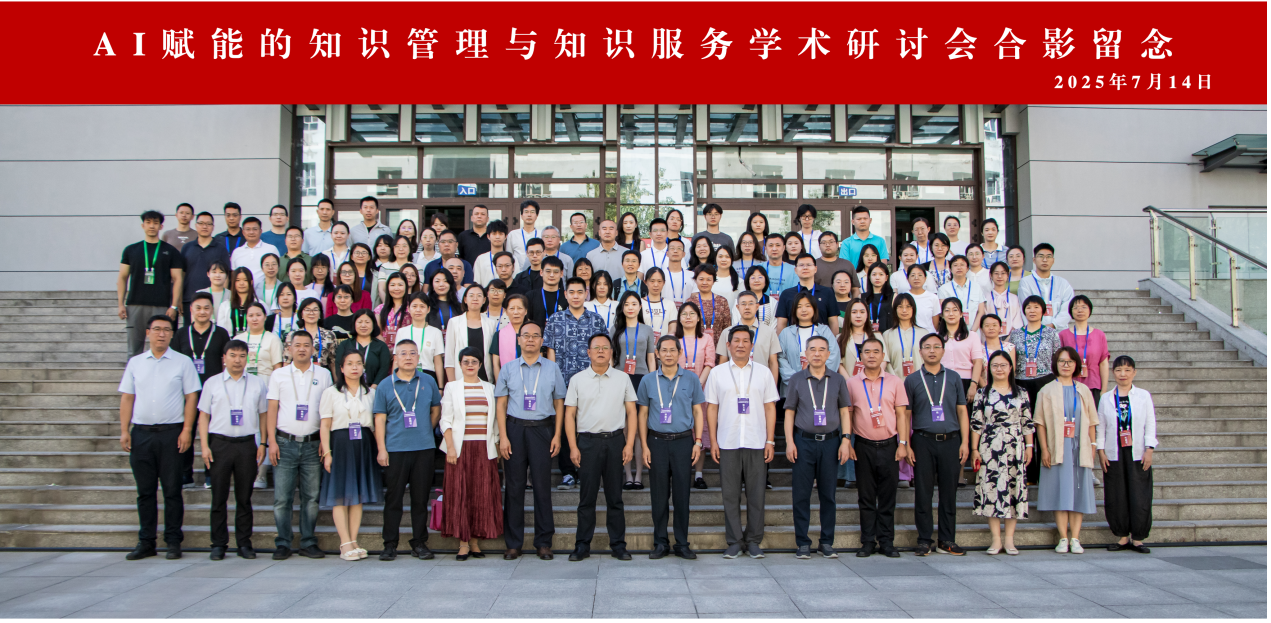
Group photo of attending experts and delegates.
The opening ceremony of the symposium was hosted by Professor Xu Chun, Deputy Director of the Faculty Affairs Office of the Party Committee of XJUFE. Vice President Li Jigang of XJUFE and Director Liu Xiwen of the NSLCAS, delivered speeches in succession.
Vice President Li Jigang began by introducing the development and key discipline construction of XJUFE. He noted that the university currently has two first-level doctoral degree programs, nine first-level master's degree programs, and fifteen undergraduate degree programs. In response to the needs of the New Liberal Arts initiative, the university was among the first to propose the development concept of "Digital Empowerment and Interdisciplinary Integration," which has since evolved with technological advances into "Intelligent Digital Empowerment," specifically referring to AI empowerment. The university has now fully implemented general education courses in artificial intelligence, achieving an organic integration between curriculum and AI. Against this backdrop, the symposium aims to jointly explore AI empowerment and its support for the entire educational process. This not only supports the cause of education but also serves to guide the future development of XJUFE. He concluded by wishing the symposium great success.
Director Liu Xiwen, on behalf of NSLCAS and Library and Information Service, extended a warm welcome to all attending experts and participants. He emphasized that knowledge is a key element in driving productivity—it is the engine that powers development. Knowledge management and knowledge services have become the most vital forms of modern production, enabling the systematic integration of knowledge. At a time of great social transformation, AI is a major driving force behind disruptive change, injecting new vitality into societal development. However, the application of AI also faces challenges in various domains, such as multimodal data integration and complex usage scenarios. AI empowerment should not be a forced grafting of technology but rather a deep integration of AI with specific fields, providing strong technological support.
In the domain of knowledge management, AI can significantly enhance the intelligence and effectiveness of knowledge selection, classification, and updating. It can also make knowledge services more convenient, accurate, and contextualized, thereby maximizing their value. In recent years, NSLCAS has actively explored how AI can empower knowledge services, pioneering the use of large language models, AI-driven data services, and providing literature and intelligence services geared toward intelligent scientific research. He concluded by stating that the power of knowledge is boundless, and the importance of knowledge management and services will continue to grow. Finally, he wished the symposium great success and hoped that all participants would gain valuable insights from the event.
On the morning of July 14, the first session of the symposium was chaired by Professor Chu Jingli, President of Library and Information Service and Editor-in-Chief of the two affiliated journals, representing one of the primary organizers of the conference.
Liu Xiwen, Director of NSLCAS, delivered a keynote presentation titled “Intelligent Agents and the Future of Scientific and Technical Intelligence Work — Alongside a Discussion on the Development of Information Science in the New Era.” In his presentation, he explored the relationship between intelligent agents and future scientific and technical intelligence work, as well as the impact of intelligent agents on the evolution of information science. He emphasized that the application of AI in future information service is inevitable and will inevitably lead to paradigm shifts in the field. Intelligent agents are characterized by autonomy, goal-directed behavior, and interaction with their environment. They reflect a way of solving problems that closely resembles human reasoning and can empower academic services in areas such as enhanced retrieval, decision simulation, and scientific hypothesis inference. As intelligent agents continue to evolve, they will become increasingly proactive and collaborative, thereby better serving scientific and technical information service and facilitating a deeper integration of information science with intelligent technologies.
Professor Li Yuhai from the School of Information Management at CCNU presented a report titled “AI Recognition from the Perspective of Knowledge Representation”. Beginning with a problem-oriented approach, he defined the concept of the “Knowledge Representation Perspective” and, based on a systematic review of its types and supporting theories, constructed a multi-perspective theoretical model of knowledge representation comprising 3 main perspectives and 8 sub-perspectives. He elaborated on the significance and function of perspective configurations. Following this, he summarized AI recognition methods, tools, and core functions from the viewpoint of knowledge representation. Building on this foundation, he proposed a framework for AI recognition of multi-perspective knowledge components, rooted in multi-perspective knowledge representation and oriented toward practical knowledge application scenarios. He concluded his presentation with a case study titled “Interdisciplinary Event Knowledge Integration Based on Library Digital Collections.”
The second session on the morning of July 14 was chaired by Professor Cao Gaohui, Dean of the School of Information Management at CCNU. Professor Chen Tingqiang, Vice Dean of the School of Economics and Management at Nanjing Tech University, delivered a report titled “AI, Knowledge Transformation, and Cognitive Innovation.” Professor Chen analyzed the essential characteristics of both knowledge and AI, and on this basis explored various paradigms of AI-driven knowledge innovation as well as the boundaries of AI-generated knowledge. He pointed out that innovation in knowledge through AI is constrained not only by technical capabilities, time, and space but also by the influences of philosophy of science, law, and society. He emphasized that the integration of AI as an “external brain” with the human mind as an “internal brain” is essential for expanding cognitive boundaries and driving continuous knowledge innovation.
Professor Huang Shuiqing from the School of Information Management at Nanjing Agricultural University presented an academic report titled “Computational Humanities Research Under the DeepSeek Paradigm.” From the perspective of large language models (LLMs), Professor Huang explained the connotation of computational humanities. After introducing the frontiers of LLM technologies and the DeepSeek technical framework, Professor Huang analyzed application scenarios of LLMs in computational humanities, including natural language understanding (NLU) and natural language generation (NLG) in literary research, historical studies, and research on classical Chinese and ancient texts. He identified key tasks that LLMs can perform in this field as well as their limitations.
He also conducted a systematic analysis of the current challenges faced in this area from several dimensions, including the scarcity of high-quality domain data, lack of interpretability, ethical risks and data bias, and the high cost and digital divide associated with the technology. Finally, he offered insights into the future prospects of typical applications within the DeepSeek paradigm for computational humanities.
The first session on the afternoon of July 14 was chaired by Professor Zhang Lingling, Party Secretary of the School of Economics and Management at the University of Chinese Academy of Sciences and Executive Deputy Editor-in-Chief of Knowledge Management Forum. Xia Shengping, Research Librarian and Deputy Director of the Dunhuang Studies Information Center at the Dunhuang Academy, delivered a presentation titled “Digital Preservation of the Cultural Heritage of the Mogao Caves in Dunhuang — The Digital Dunhuang Project”. Centered on the Digital Dunhuang Project, he introduced the Academy’s efforts in creating a digital archive of mural image resources from the Dunhuang caves, and shared practical experiences in the holistic planning, systematic management, knowledge mining, and intelligent services related to massive digital assets. He discussed how digital humanities technologies are being leveraged to achieve the long-term preservation, inheritance, and utilization of this precious cultural heritage.
Professor Cao Gaohui, Dean of the School of Information Management at Central China Normal University, gave an academic report titled “Research on the Construction of Foundational Datasets for Domain-Specific Large Models.” Professor Cao reviewed the development of large models from four dimensions: disciplinary development, scientific research, talent cultivation, and social service. He emphasized that data serves as the core "nourishment" for large models and, through examples such as the open-source project KnowLM and Alibaba’s Qwen3 model, analyzed the foundational role data plays in the practical construction of large models. He also outlined five key areas for future research: (1) dataset construction and governance, (2) data quality monitoring and evaluation, (3) cross-modal and cross-domain data integration, (4) collaborative optimization between domain data and models, and (5) domain-specific data sharing and ecosystem development.
The second session on the afternoon of July 14 was chaired by Professor Guo Jinzhong, Vice Dean of the School of Information Management at XJUFE. Professor Zhang Lingling, Party Secretary of the School of Economics and Management at the University of Chinese Academy of Sciences and Executive Deputy Editor-in-Chief of Knowledge Management Forum, delivered a presentation titled “AI-Enabled Scientific Data and Knowledge Management for Major Scientific and Technological Infrastructure.” Starting with the definition, classification, and characteristics of major scientific infrastructure, she explored the management and optimization of scientific data generated by such infrastructure, as well as how large language models can enhance the automated extraction of unstructured scientific data. She proposed that future research should advance along five key dimensions: system frameworks, user demand, data supply, demand-supply alignment, and empirical validation.
Qian Li, Director of the Data Resources Department at the National Science Library, Chinese Academy of Sciences, presented a report titled “Research and Application of Prompt Engineering for Deep Multimodal Knowledge Extraction from Scientific Literature.” By analyzing the application architecture of large language models, he clarified integration pathways between large models and scientific intelligence work. He highlighted prompt engineering as one of the key drivers of large model capability advancement. Qian outlined the principles and technical framework of prompt engineering, demonstrated several multimodal applications, and shared insights on future development trends in the field.
Dr. Qiu Zhaoliang, Chief Consultant at Beijing XueEr Management Consulting Co., Ltd., gave a presentation titled “A Systemic Framework and Practical Exploration of AI-Enabled Organizational Learning and Knowledge Management.” Dr. Qiu shared his perspectives and practical experience on how AI empowers organizational learning and knowledge management. He emphasized that while AI presents challenges for organizational learning, it also offers significant opportunities to reshape skills and business processes. Dr. Qiu built a "Nine-Grid Framework" for organizational learning based on AI’s applications at the individual, team, and organizational levels, and structured the analysis around three dimensions: adaptive innovation, knowledge operations, and social interaction. Finally, drawing from case studies, he proposed a systematic solution for enterprises to embrace AI and accelerate the development of learning organizations.
On the morning of July 15, the first session of expert presentations was chaired by Du Xingye, Research Librarian and Managing Editor of the journals Library and Information Service and Knowledge Management Forum. Professor Guo Jinzhong, Deputy Dean of the School of Information Management at XJUFE, delivered a presentation titled “A Generalized Input-Output Analysis of the Importance and Evolution of National Disciplinary Fields within the Context of Knowledge Dissemination Networks.” Addressing the issues of evaluating disciplinary development from a national strategic perspective and the cross-disciplinary flow of knowledge between different countries, he introduced the methods his team employed, which involve constructing input-output matrices and knowledge flow networks using citation relationships between academic achievements. He also conducted empirical research using data from the American Physical Society and Microsoft Academic, providing references for policymakers to design more precise science and technology support policies, identify future research hotspots and trends, and strategically plan disciplinary development in advance. Professor Tang Qiong, Deputy Dean of the School of Information Management at Sun Yat-sen University, delivered a report titled "AI Competency of Librarians in the AI Era: Framework Construction and Implementation Pathways." She conducted an in-depth analysis of the transformations and challenges libraries face in the AI era, as well as the theoretical foundation and core elements of the AI competency framework for librarians. She pointed out that this framework will play a significant role in library talent recruitment, skill training, self-assessment, and library automation transformation. In the future, only by cultivating librarians with AI competencies can libraries better address various uncertainties. Wu Junhong, Director of the Literature Evaluation Center of the China Academic Journals (CD-ROM Edition) Electronic Magazine Press, delivered a presentation titled “AI-Empowered Knowledge Management: The Intelligent Transformation and Practice of Evaluation Products.” She argued that AI large models are reshaping the entire publishing process, driving changes in content production methods. The construction of trustworthy large models that integrate high-quality data with large language models is promoting the upgrading and transformation of knowledge service products. She introduced the digital and intelligent transformation of academic evaluation and AI applications using scenarios such as achievement evaluation, talent evaluation, and institutional/disciplinary evaluation. Finally, she proposed development suggestions in areas such as the construction of a multi-dimensional dynamic evaluation indicator system, the application of dynamic knowledge graphs, forward-looking predictive evaluation, and the safeguarding of academic ethics.
The second session on the morning of July 15 and the afternoon of July 15 were dedicated to the “Paper Presentation Session”, hosted by Yi Fei, Deputy Editor-in-Chief of Library and Information Service. A total of 51 papers were submitted for this conference. After reviewing the submissions, the editorial boards of the two journals selected 36 outstanding papers. The conference invited six authors of outstanding submissions to deliver presentations at the plenary session, with on-site comments provided by experts (Guo Jinzhong, Xia Shengping, Tang Qiong, and Wu Junhong) and the editorial board (Du Xingye and Wang Chuanqing).
Following a brief interactive session and conference summary, the 2025 Symposium on AI-Empowered Knowledge Management and Knowledge Services concluded successfully. The conference provided research and practical pathways for the development of knowledge management and knowledge services in the AI era, and outlined future directions. Experts and participants expressed that they gained valuable insights and practical guidance for their work, and look forward to participating in future conferences on the same theme.
Library and Information Service
School of Information Management, CCNU
School of Information Management, XJUFE
July 2025


